 Published
Updated
Specify the printed surface as well as the board. Direct printing and an applied printed-vinyl construction can produce different results, update options and maintenance requirements.
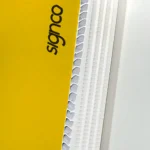
A direct print places the image onto the board through the proposed print process. An overlay construction applies a separately printed layer. Ask whether either includes a protective layer and what each layer is intended to do.
Do not infer scratch resistance, removal behaviour or outdoor life from the print-method name alone. The actual ink, film, protective layer and substrate combination matter.
| Check | Useful comparison |
|---|---|
| Colour appearance | Representative artwork on the proposed material |
| Glare | Viewing under relevant lighting and angle |
| Fine text | A print-size sample at the intended distance |
| Edges | How any applied layer finishes around cuts and corners |
| Updates | Whether a change requires a new face or a complete board |
| Care | Approved cleaning and handling for the construction |
A sample of a bright photograph is not enough if your sign contains fine diagrams or small type. Include the hardest part of the design in the proof. Check dark areas, gradients and the main contact detail.
For a hypothetical retail board behind a window, reflections from the glazing may dominate the result regardless of the printed surface. Test the complete viewing arrangement rather than requesting a “non-glare” label and assuming the problem is solved.
Include the finish in the order confirmation, alongside material, size and mounting. If a replacement is needed later, supply that record rather than asking for “the same board” from memory.
Use the substrate comparison and outdoor exposure checks. Poster finish selection uses a related viewing test but concerns a different print format. Ask the board supplier for sample constructions matched to the application.
Choose using the actual application, appearance, update needs and product specification.
It may serve a specified protective purpose, but it is not a guarantee against all damage.
Ask whether the existing substrate and proposed update process are suitable.
Agree the proof and colour expectations for the actual production process.
Ask for sample constructions and a final-size readability proof. Explore SignCo’s Foamex boards or contact the team.